
%2520copy.webp&w=3840&q=75&dpl=dpl_AWpVNSZhwpgKPseVcRPFNjMNnxdw)
History
The Sphinxes of Peristil: Egyptian Statues in Diocletian's Palace, Split
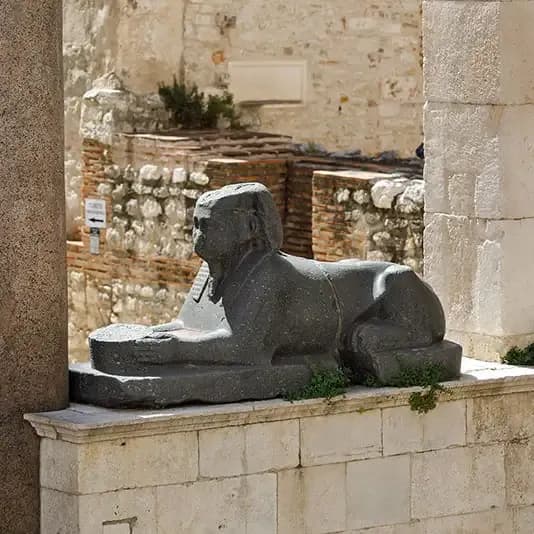
Most visitors to Peristil look up: at the columns, at the bell tower, at the sky framed in stone. The sphinx lies low, at the edge of the square, and it is easy to walk past. It is also the oldest object you will see in Split that day, by several thousand years.
A statue older than the palace it stands in
The sphinx on Peristil was carved in Egypt during the reign of the pharaoh Thutmose III, who ruled in the fifteenth century BC. That means the statue was already around seventeen centuries old on the day it was set down in Diocletian's Palace. Standing on the square, you are looking at an object that was an antique to the Romans.
It is cut from Egyptian granite, quarried in the south of the country and carried down the Nile for centuries. That dark, hard stone is the reason it has survived three and a half thousand years in the open air.
Why an emperor shipped them at all
Diocletian ruled an empire that held Egypt as a province, and Egypt in the Roman imagination was what antiquity is to us: older, stranger and more prestigious than anything domestic. Pharaohs had set sphinxes before their temples as guardians, and that symbolism was exactly what the emperor needed. Diocletian built his authority on the idea of divine descent, and a row of Egyptian guardians around a ceremonial courtyard said so without a single word.
The sphinxes were not decoration. They were a message, placed along Peristil, the square where the emperor showed himself to his subjects and where every approach to him was staged down to the last detail.
How many there were, and where they are now
Around a dozen are thought to have reached the palace. Only one survives intact and in place, the one on Peristil. A second, headless, lies in front of the former Temple of Jupiter, which has since become a baptistery. The rest were broken, moved, or ended up in museum collections.
The reason is not neglect but history. When the palace became a town in the Middle Ages, pagan statues were unwelcome, and many were destroyed for precisely what they represented.
Where the name Lvxor comes from
The Egyptian city those sphinxes came from is now called Luxor. That is where our name comes from. The statue beside our entrance is not a prop we placed there; it is part of a square that was here before us and will be here after us. We simply named ourselves after the place it travelled from.
What else to look at on the square
While you are on Peristil, three more things are worth your attention. The Cathedral of St Domnius was originally Diocletian's mausoleum, which means the tomb of an emperor who persecuted Christians became a church dedicated to a Christian martyr. Facing it stands the baptistery, once the Temple of Jupiter. And beneath the square, through the palace substructures, you can read the floor plan of the imperial apartments that once stood above them.
All of it sits within a few dozen metres. The sphinx is the oldest thing in that circle, and the only one that was already ancient before the Romans arrived.